

 Tanika Gupta’s latest play Hedda is not only inspired by Henrik Ibsen’s 1891 play Hedda Gabler, but follows quite closely the plot lines while resetting it in London in 1948. The male characters become film producers and writers rather than academic authors. This device enables her to explore the impact of both the American cinema Hays Code (which operated from 1930 to 1968 and included a clause of no “miscegenation” – no romantic relationships between people of different races) and the impact of India’s independence in 1947 from its colonial past. We were previously unaware of both contexts and therefore the adaptation offered an interesting insight into the shocking implications of both. The programme reveals that Merle Oberon suppressed her Asian ethnic origin in order to be seen as acceptable to cinema audiences.
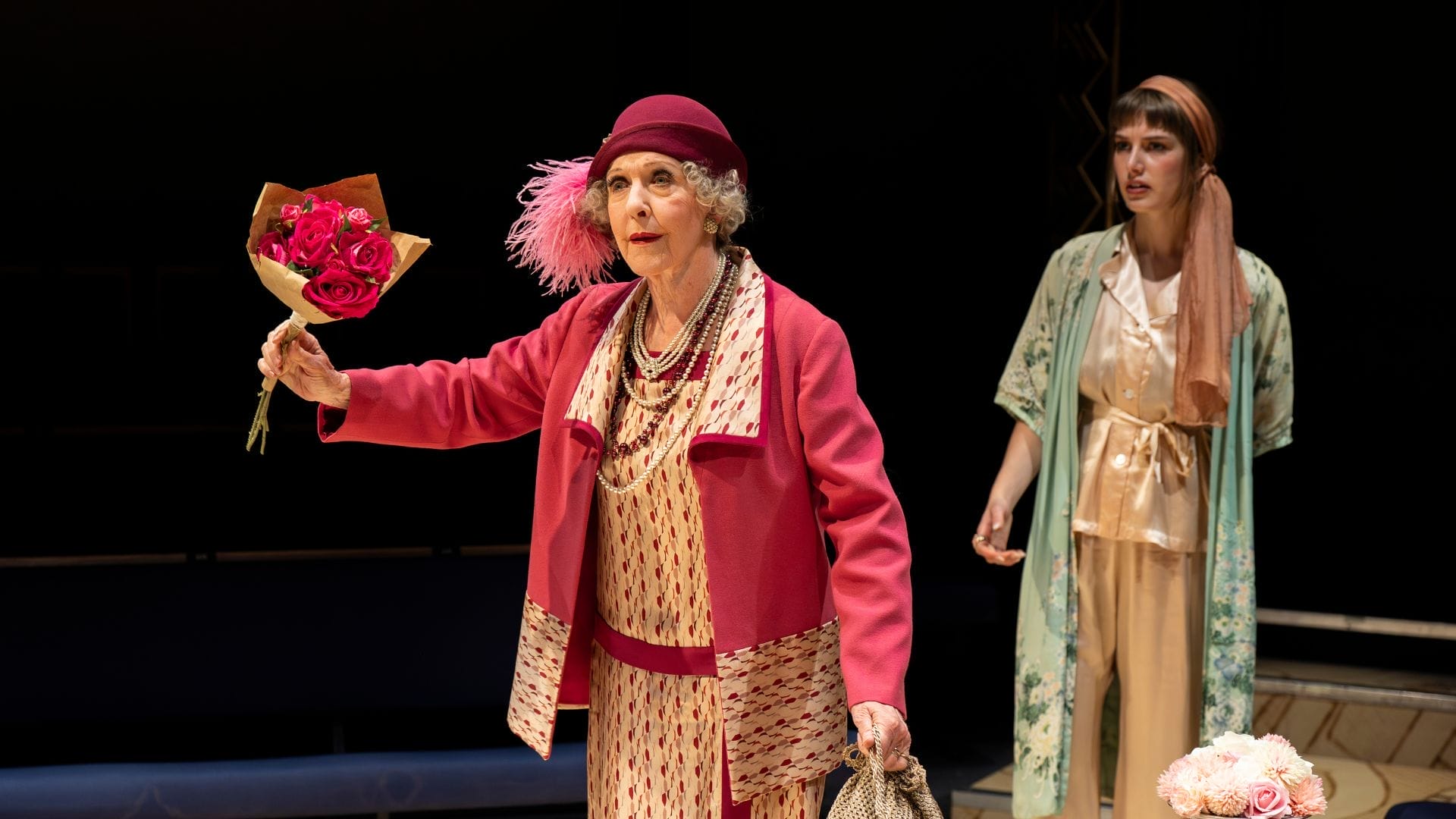
Gupta weaves these themes into the original plot lines, creating a disturbing web of relationships and rivalries which ultimately have dreadful consequences. The retired screen actress Hedda Gabler, daughter of General Gabler, played by Pearl Chanda, has returned from a six-month honeymoon with her new, fourth husband, scriptwriter George Tesman (Joe Bannister), who is desperate to make his next film to finance their lifestyle. The powerful film financier, John Brack (Milo Twomey), arrives and explains that rival scriptwriter Leonard (Jake Mann) has a new script that they might back instead of George’s. To add to the intrigue, Alice Smith (Bebe Cave) has left her husband to support Leonard in his writing and re-establish him as a writer while recovering from alcoholism.
This much follows the original story, but what adds to the intrigue is the repositioning of the faithful servant as Shona (Rina Fatania), loyal to the General and Hedda for reasons that are perhaps too apparent too early on, and the revelation that Leonard is a child of a mixed-race relationship. We see Shona dabbing pale powder on Hedda and closing the net curtains to keep out the harsh sunlight as hints of her true background.
Gupta and Director Hettie Macdonald seem to stylise much of the speech as if they are film actors speaking their lines, and in the intimate setting of the Orange Tree Theatre in the round, we are too aware that we are watching performances. This may be a deliberate choice, as many of the characters are duplicitous – saying one thing but meaning or hiding something else. Only three characters truly ring true throughout. Caroline Harker’s elegant Aunt Julia, representing the colonial past, convinces of her love for George, her suspicion of Hedda, and her love of a lost life in India before the War. Fatania as the “maid” Shona is equally impressive – an ever-present in Hedda’s life, a quietly strong woman with knowing glances and carefully chosen words, although it is curious and disturbing to see her load the General’s pistols that Hedda has. The standout scenes are those featuring Mann’s Leonard, as we gradually learn of his own backstory, see his response to being taunted and teased by Hedda, and then witness his disintegration through alcohol, unaware of how he has been manipulated by Hedda.
Of course, the story revolves around Hedda, and Chanda creates this monster of a character – demanding, headstrong, manipulative, deceitful, and needy. As Alice says to her, “you are always saying things you don’t believe yourself,” and she lives with the fear that she “will reveal who you really are and you will be destroyed.” The challenge is making this artificial image believable while revealing the truth to us, and despite a strong performance, we were never quite convinced by the artificiality of the character or her response to being trapped by her ethnic background.


For once, this is a reimagining of a classic play that adds intrigue and insight, and Hedda is a very clever conceit. We are genuinely shocked to rediscover the attitudes towards mixed-race relationships and the banning by Hollywood of them or artistes with that background in this period. The use of terms like Anglo-Indian, outcasts, or worse are disturbing, and of course, the ending – like in the original play – is horrific. The closeness of the audience to the performers acts against this tale. Whereas in the last production here, Creditors, that intimacy added to the enjoyment, here we often felt we were seeing too much in close-up without feeling drawn in or involved in the story. Only in the wonderful opening scene, as Shona engages every member of the audience in a short stare, do we have that sense that we are guilty onlookers, in part to blame for the situation that will unfold.
However, once again the Orange Tree has delivered another very fine production with a good cast and continues to deliver for the Richmond audiences.
Listings and ticket information can be found here.