
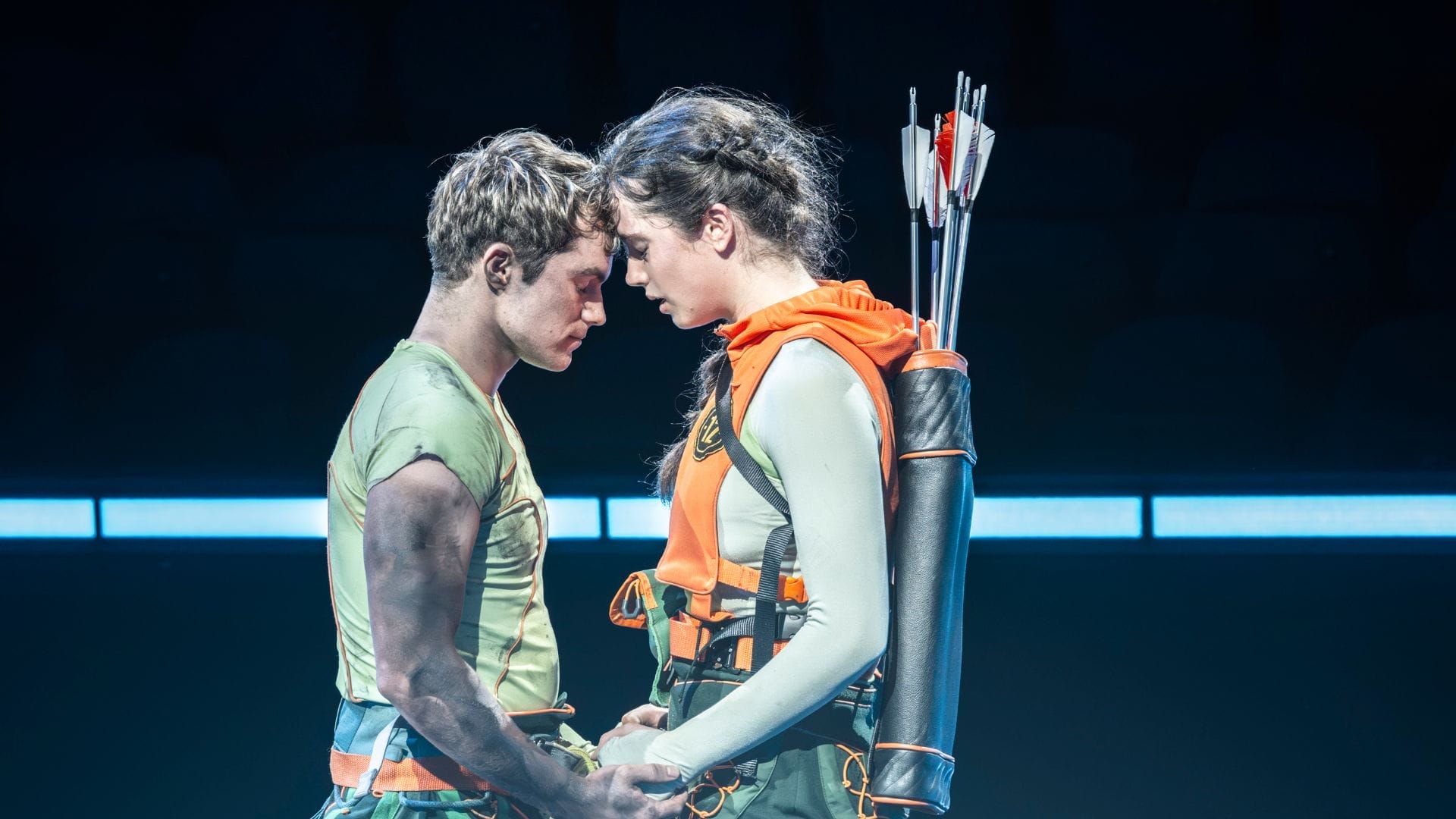
 The Hunger Games has always thrived on tension, moral ambiguity and the raw terror of survival. Conor McPherson’s stage adaptation, directed by Matthew Dunster, arrives at the brand-new Troubadour Canary Wharf Theatre with ambitions as towering as its LED screens. Unfortunately, despite its visual bravado, this production rarely hits the emotional bullseye.
The concept is undeniably impressive. The venue itself feels like an aircraft hangar repurposed for dystopia, with a circular stage encircled by colossal video panels and industrial walkways. Audience members are seated by “district”, a clever immersive touch that sets the tone before the show begins. From the opening moments, cinematic underscoring and sub-bass rumbles promise a visceral experience. For a while, it delivers.
Act One introduces Panem with striking design flourishes. The Reaping scene is taut and chilling, and the Capitol’s propaganda spectacle is jaw-dropping. John Malkovich’s pre-recorded appearances as President Snow are the evening’s masterstroke. His reptilian calm and measured menace dominate the room, even from a screen. Each syllable drips with threat, and the audience audibly responds whenever he appears. Ironically, the most magnetic performance of the night belongs to someone who never steps on stage.
Elsewhere, the adaptation struggles. Heavy-handed narration intrudes repeatedly, flattening moments that should breathe. Mia Carragher’s Katniss has physical strength and flashes of vulnerability, but the script rarely allows her interior life to surface. Tom Quinn’s Peeta remains a gentle presence without real spark, while Frances Maynard’s Effie veers into broad comedy that jars against the grim stakes.
Act Two injects energy with inventive arena staging: rising platforms, aerial harnesses and drone-assisted camera feeds create a kinetic spectacle. Combat sequences are stylised and elegant, though sanitised to the point of abstraction. Rue’s death finally pierces the emotional fog, yet even here, a voiceover undercuts the silence. The climactic confrontation fizzles amid misaligned flame projections and tech-heavy clutter, leaving the resolution oddly weightless.


Technically, the production is a marvel. Screens integrate seamlessly with live action, save for a brief flicker, and the sound design envelops the space. But dazzling visuals cannot compensate for a hollow core. McPherson’s adaptation pares away the psychological nuance that made Suzanne Collins’s novel compelling, replacing it with exposition and spectacle. Dunster’s direction favours movement over meaning, resulting in a show that feels more like a theme park attraction than a drama of rebellion and survival.
Troubadour Canary Wharf Theatre deserves applause for ambition, and fans of the franchise may revel in its immersive trappings. Yet for all its scale and polish, The Hunger Games: On Stage leaves you starved of genuine emotional fire.
Listings and ticket information can be found here