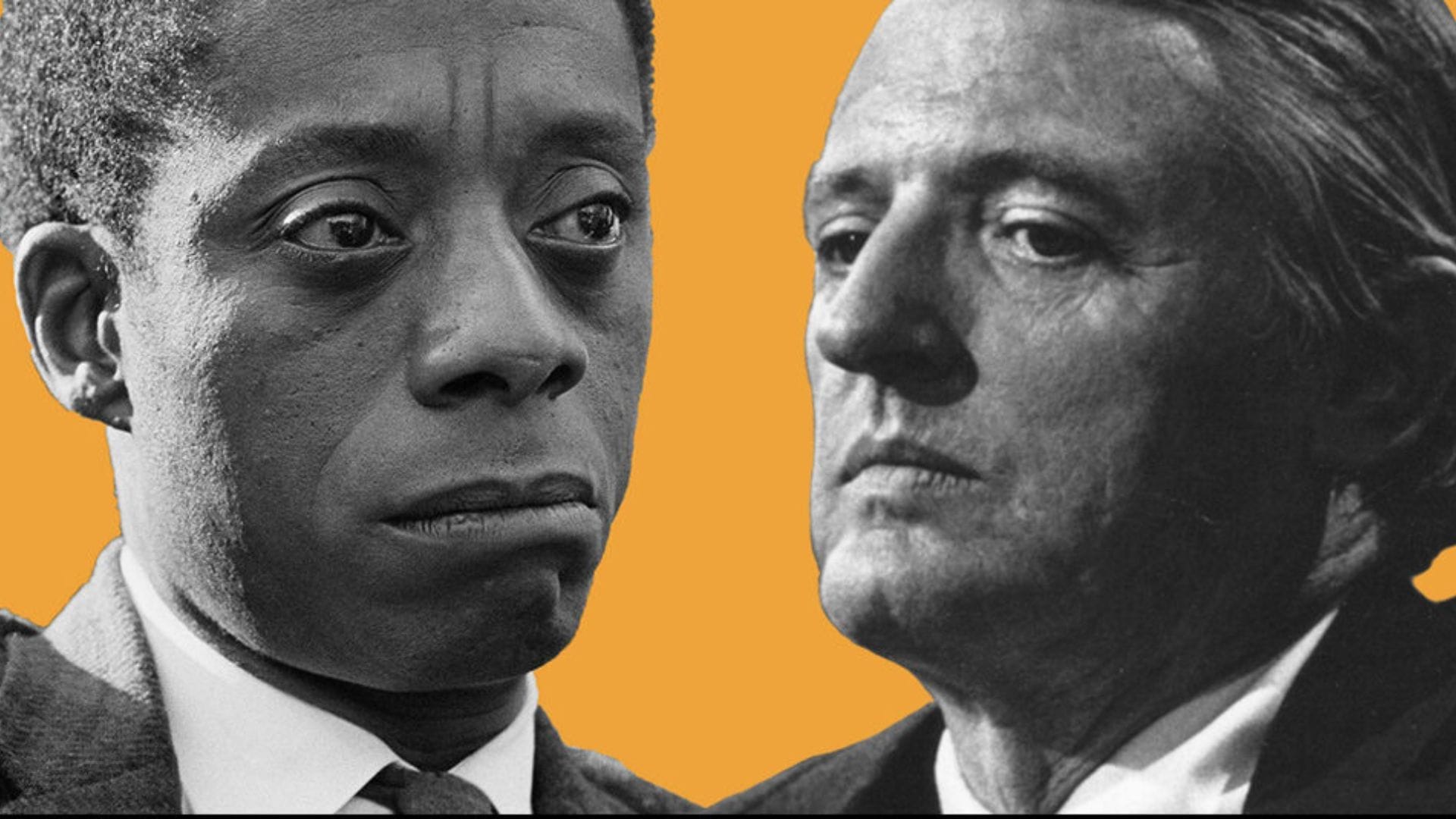


 At Wilton’s Music Hall in London, Debate: Baldwin vs Buckley revisits the historic 1965 Cambridge Union debate that asked whether the American Dream had been built at the expense of Black Americans. Restaged by the american vicarious and directed by Christopher McElroen, the production presents the original debate text verbatim, inviting a contemporary British audience to encounter a defining moment in American political and cultural history.
Structured as a sequence of extended monologues, Debate: Baldwin vs Buckley places four performers on an otherwise empty stage, seated on simple chairs with minimal staging and projection used to fill in the gaps of the absent moderator. The emphasis is firmly on language. Baldwin’s words remain exceptionally powerful, charged with anger, yet marked by restraint and an insistence on dialogue rather than domination.
Arnell Powell delivers Baldwin’s text with restraint and intelligence, allowing its emotional precision to emerge without exaggeration. Eric T. Miller presents William F. Buckley Jr.’s arguments with measured confidence, articulating the ideological tension of the debate without reducing it to caricature. However, the limited interaction between the performers results in long stretches in which dramatic tension dissipates, with the debate unfolding more as parallel testimony than as a living exchange.
What is most difficult to recreate is the moral charge of the original event. In the 1965 footage, Baldwin famously describes himself as “Jeremiah”, a figure who loves his country enough to warn it of its own destruction. His role is not to curse America, but to sound an alarm: that without confronting the realities of racial injustice, the American Dream will collapse under the weight of its own denial. When Baldwin finishes speaking and the audience rises in sustained applause, followed by his own astonished laughter, something rare occurs, a moment in which truth briefly crosses ideological boundaries.
In a London theatre in 2026 those conditions cannot be assumed. The audience is international, politically heterogeneous, and already familiar with Baldwin as a canonical figure. Yet Debate: Baldwin vs Buckley largely relies on projection and historical reference rather than engaging with the unstable, reactive dynamics that shaped the original exchange. The interruptions, tensions, and charged audience responses that gave the 1965 debate its temporal density are largely absent. As a result, viewers observe a significant historical event rather than being drawn into its urgency, a loss that feels particularly striking given the evident care with which the production preserves Baldwin’s original words.


As a presentation of a vital historical text, Debate: Baldwin vs Buckley remains compelling. As theatre, it feels cautious, missing opportunities to actively reframe Baldwin’s words for a different place, time, and audience.
Listings and ticket information can be found here