

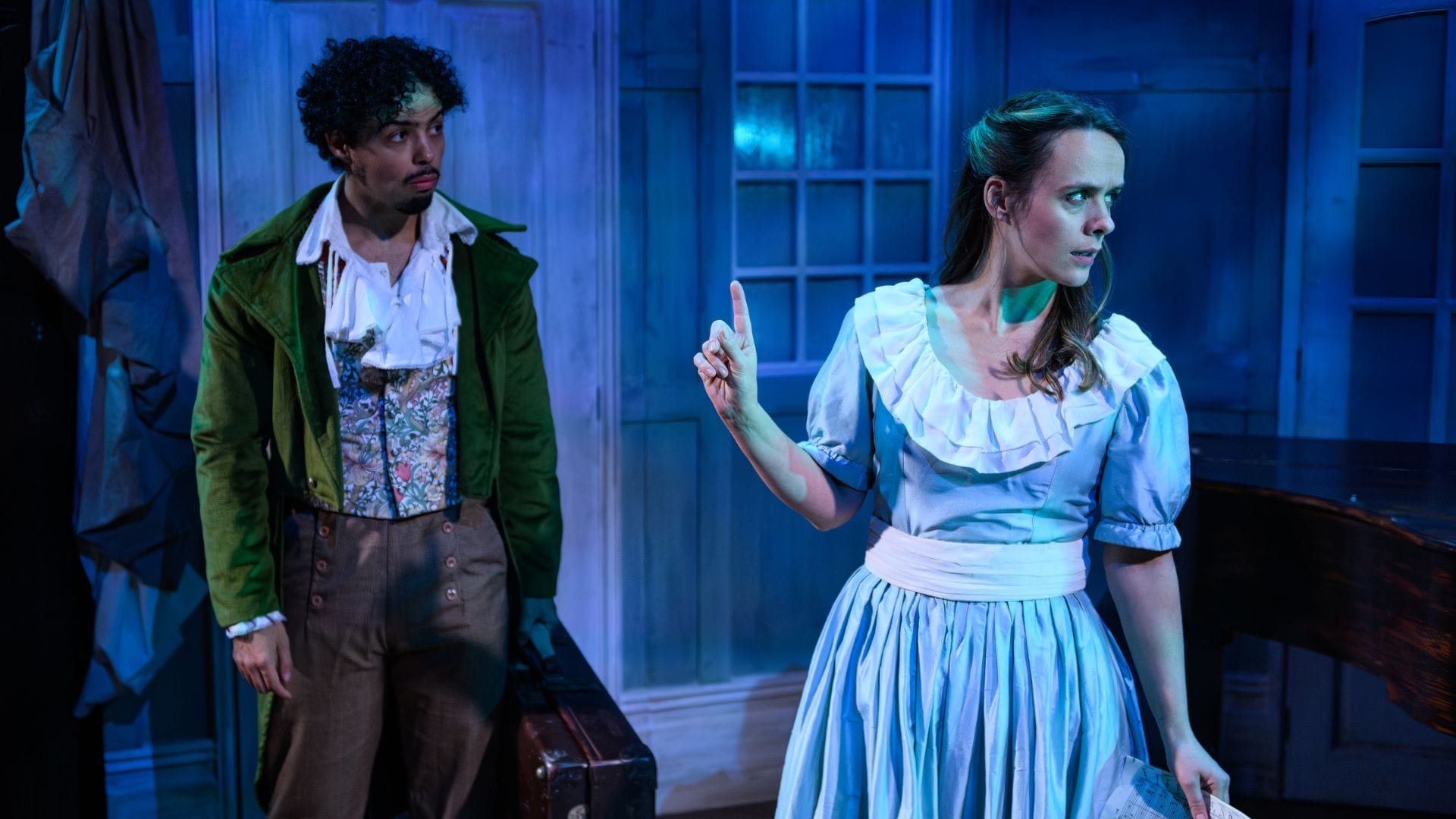
 Calum Finlay’s play, Fanny, now at the King’s Head Theatre following a previous run at the Watermill, is a spirited and irreverent take on the life of Fanny Mendelssohn, the often-overlooked sister of famed composer Felix Mendelssohn. Directed by Katie-Ann McDonough, this production brings a fictionalised yet well-researched version of Fanny’s story to the stage, blending historical fact with a healthy dose of comedic invention.
The play opens in 19th-century Berlin, where Fanny, a gifted composer, lives in the shadow of her brother’s fame. When she intercepts a letter inviting Felix to perform for Queen Victoria, she seizes the opportunity to step into the spotlight herself, setting off on a bold and rebellious journey to London. It’s a premise ripe with potential, and Finlay’s script doesn’t shy away from highlighting the gender politics of the time, portraying Fanny as a fiercely independent woman determined to claim her rightful place in the musical canon.
Charlie Russell, best known for her work with Mischief Theatre, reprises her role as Fanny with charm and versatility. She brings a magnetic presence to the stage, particularly shining in a standout audience participation scene at the start of Act Two. Her background in improvisation is evident here, and it’s in these moments that the production feels most alive. Kim Ismay also delivers a strong performance as Lea, offering a grounded counterpoint to the more chaotic elements of the show.
Sometimes, though, the play struggles to hit the right beat. The first act feels overly long and somewhat meandering, taking too much time to reach the pivotal moment of Fanny’s departure for London. The tonal shifts between earnest drama and broad farce can be jarring, occasionally undermining the emotional weight of Fanny’s struggle. The second act is more cohesive and engaging, though the audience interaction scene, while delightful, feels out of step with the rest of the play’s structure.
Visually, the production is a treat. Sophia Pardon’s costume design is sumptuous and evocative, and the set offers enough visual flair to keep the eye engaged without overwhelming the action. Yet, the direction occasionally falters in pacing, and the supporting characters, while energetically performed, lack the depth to make them truly memorable or sympathetic.


For those unfamiliar with the Mendelssohn family tree, the narrative may prove a little confusing, as the relationships between characters are not always clearly defined. Still, the play succeeds in its central mission: to celebrate a woman whose contributions to classical music have long been overshadowed.
Fanny is an often funny tribute to a trailblazing woman, and with some further refinement could live up to its potential. While it doesn’t always hit the right notes, it’s a heartfelt and entertaining evening that gives Fanny Mendelssohn a long-overdue moment in the limelight.
Listings and ticket information can be found here.