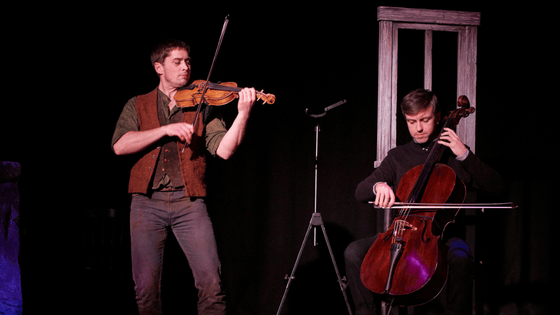


 Lucy Beth is offering us something special at the Fringe because not only is she telling the reimagined story of Isabelle from the well-known bothy ballad, but she actually plays Isabelle. Ma Name Is Isabelle offers Lucy Beth a platform for a perspective that was never told.
Without being acquainted with the Doric dialect or the ballad, it is still possible to follow this production, as it is wholeheartedly portrayed. Beth’s physical and vocal talents shine through, rooted in the heart of the North West of Scotland, and the audience are ready to experience it.
Last year, Lucy Beth was nominated for the ‘Artist of the Year’ award by the Scottish Emerging Talent Awards, and from the onset it is clear why, Isabelle is brought to life as Beth presents a hypothetical scenario with plausible storylines.
Isabelle, in bringing forth her story, finds a voice, a narrative, and gets to express what’s been potentially missing for years, the void of Isabelle’s actual part in the story. First written in 1865 by John Geddes, the Bogie’s Bonnie Belle lyrics have been modified with various versions.
Lucy Beth steps into character with ease, just like a natural progression, as she is native to Isabelle’s land and turf. She is at once feisty, rugged and composed. She relives her traumatic experiences with James Stephen, including a non-consensual encounter and the resulting out-of-wedlock pregnancy.


Disowned by her father and with the combined pressure from her family, the Kirk, and Stephen’s uncle, the baby is taken from Isabelle’s arms. Now distraught with grief, she plays out narratives where her son may actually be within her sight and she simply would not know it.
The production is short at forty-five minutes, and I wonder if it is too condensed. Without reference to the actual ballad, could it leave the audience a bit indifferent without access to the original source? Also, despite its authenticity, we know very little about her present status, being married to a tinsmith, and as Isabelle has won us over, we care and may be left curious.
Isabelle in the present, with a family of her own, communicates with vivid clarity the anguish of having a first child out there, and she hopes so very much that he is still alive.
The dialogue is powerful, with an additional element: rhyme, which gives the performance notable enhancement.
Ma Name Is Isabelle speaks volumes about the historical context, and now Isabelle’s name has a place. She is far more than an accessory to a man, but rather a soul filled with humility and grace, facing uncomfortable truths. Lucy Beth is a joy to witness.