

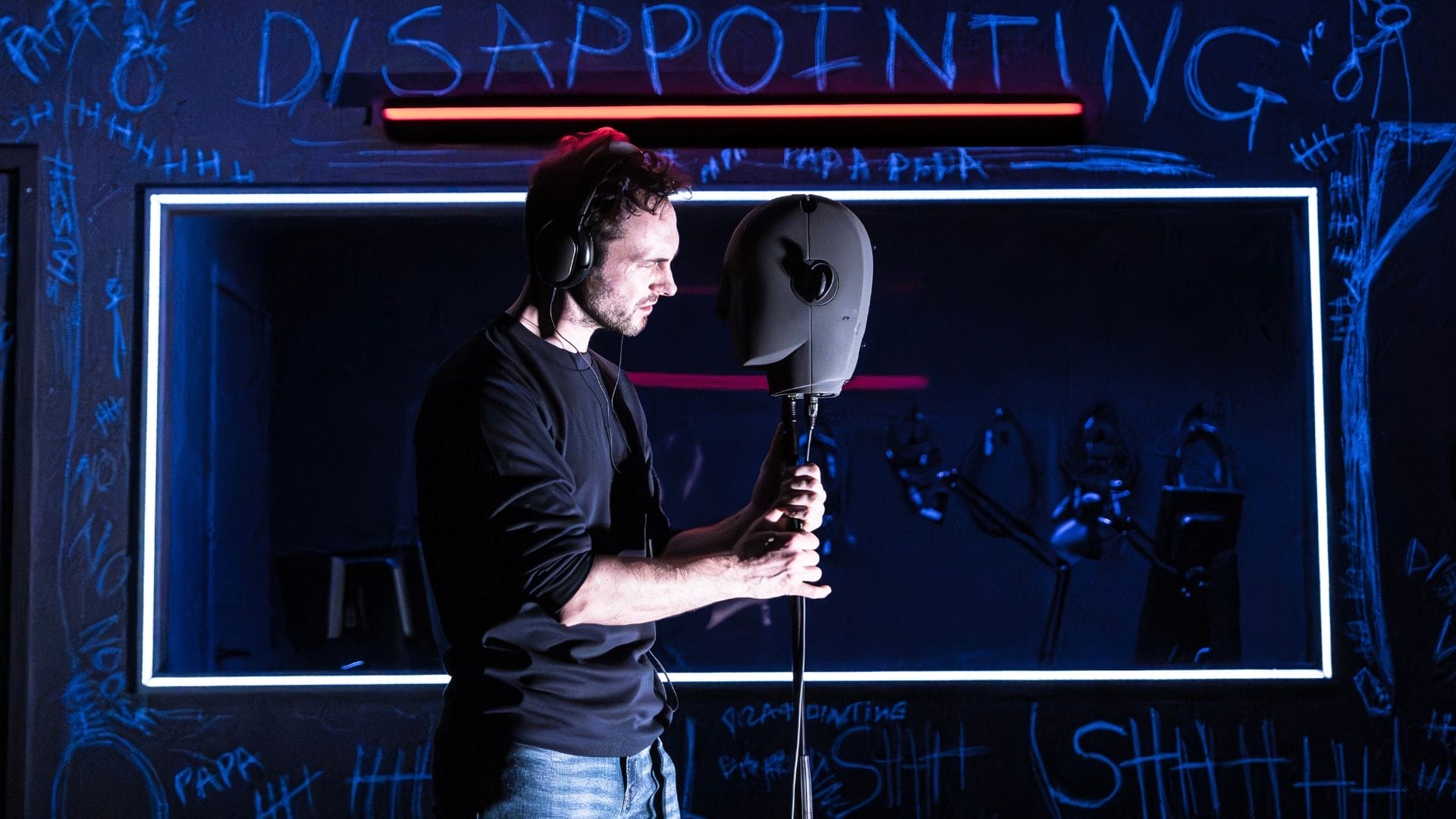
 Jamie Armitage’s A Ghost In Your Ear invites us into a world where sound becomes the primary conduit for terror. Hampstead Theatre Downstairs has transformed into a recording studio, its glass walls enclosing the actors while initially acting as a reflective surface that mirrors the audience back as spectral figures. Bathed in an ominous red glow before the action begins, the atmosphere is unsettling from the start, and that sense of disquiet never quite leaves.
The premise is deceptively simple: an actor arrives late for a last-minute job, tasked with recording an audiobook of a chilling ghost story. But as the session unfolds, the horrors seep beyond the script, haunting the studio itself. It’s a clever conceit, and Armitage, collaborating with sound designers Ben and Max Ringham, exploits it fully through binaural sound technology. Audience members wear headphones throughout, immersing us in whispers, creaks and sudden jolts that feel as if they originate inside our own skulls. At times, the experience borders on ASMR, with hushed voices brushing against the ear, creating an intimacy that is both soothing and sinister.
Ben and Max Ringham’s sound design is undoubtedly the star, and while there are moments where the binaural microphone seems employed for novelty rather than necessity, the overall effect is gripping. There were times I was tempted to close my eyes and surrender to the audio alone, but doing so would have meant missing the visual tension and the occasional jump scare that punctuates the piece.
George Blagden delivers a commanding performance as George, the actor within the play. His portrayal of a performer navigating the mechanics of recording while gradually succumbing to fear is nuanced and compelling. Long, intricate monologues are handled with precision, and his ability to convey mounting dread without tipping into melodrama anchors the production. Jonathan Livingstone’s Sid begins as a playful foil, but his growing detachment feels underwritten, even if the eventual explanation offers some clarity.
Thematically, the play touches on the endurance of ghost stories across generations and the complexities of father-son relationships, though these ideas sometimes feel secondary to the sensory thrills. Still, Armitage’s script ensures that the scares are not empty: there is substance beneath the shivers.


If the use of headphones recalls experiments seen in productions like the Donmar’s Macbeth, here it feels particularly apt. The innovation suits the genre, and while not every choice lands perfectly, the ambition is admirable. A Ghost In Your Ear is a bold, atmospheric piece that redefines how we experience theatre, proving that horror can thrive in the intimacy of sound as much as in the spectacle of sight.
Listings and ticket information can be found here