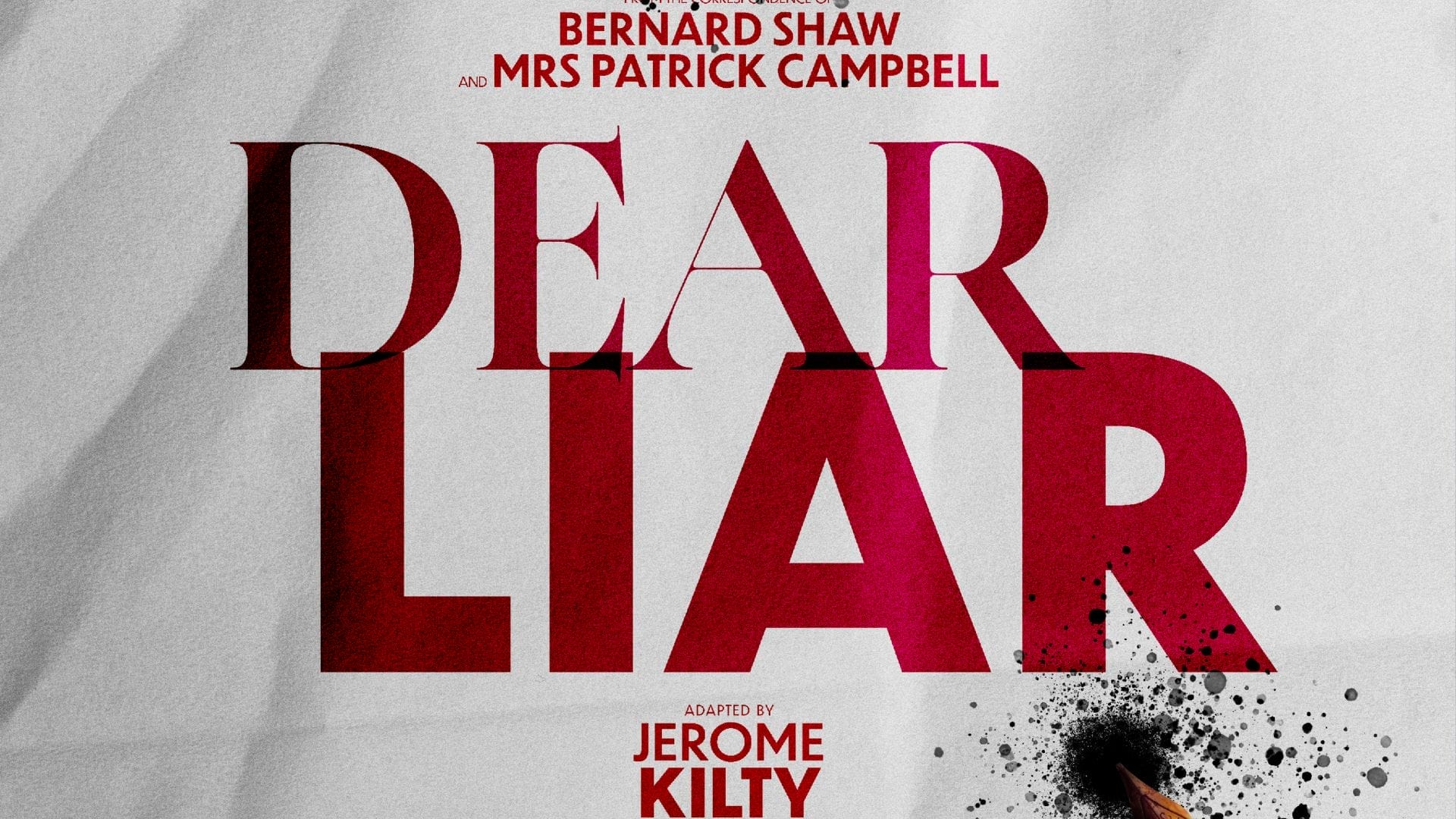



 George Bernard Shaw and Mrs Patrick Campbell, two theatre titans of the early twentieth century, shared a close working relationship during Shaw’s Pygmalion, a great theatrical success in 1914. A century later, while much of Shaw’s repertoire has stepped away from the mainstream canon, Stella Powell‑Jones revisits Jerome Kilty’s adaptation of their correspondence. Thanks to a now‑romanticised hat box, a flirtatious, witty and intellectually charged relationship is revealed.
Initially, Powell‑Jones’s direction feels like a verbatim play. Shaw (Alan Turkington) reads aloud his first random letter to Patrick (Rachel Pickup) about an afternoon tea invitation, which is declined by Patrick outright. As the light (Chris McDonnell) gradually dims, their exchanges grow increasingly fevered, and verbatim letter recital merges into imagined reconstructions of their meetings. Patrick promises to be Shaw’s “pretty slut” and the pair start rehearsing to improve her over‑exaggerated Cockney accent. Shaw chases Patrick to the seaside no matter how reluctant Patrick is. When Patrick’s son dies during the war, Shaw refuses to offer sympathy.
While Harry Blake’s typewriter‑like soundscape underscores the pair’s correspondence, Tom Paris’s design of three sets of patterned curtains divides this black‑box theatre into even smaller sections. However intimate they are, emotionally and intellectually, there are always clear boundaries between Shaw and Patrick not out of normative moral codes, but because of the showy, performative nature of their relationship, in which bare, unfiltered sincerity feels almost impossibly rare. These moments do sparkle in the second half when the pair are growing old and Shaw repeatedly writes “we won’t meet again”. Saint Joan becomes another success, but Patrick doesn’t enjoy the same luck in Hollywood. Their encounters remain witty, but the edges begin to dissolve.
This two‑hander wouldn’t be enjoyable enough without Turkington and Pickup’s portrayals, rendering the pair’s chemistry dry, witty and deadly funny. Turkington’s Shaw is boyish and slightly sassy, while Pickup’s Patrick is intemperate but decisive. Clearly, Powell‑Jones handles the rapid‑fire quick wits more comfortably, but is less confident when directing more emotive monologues and encounters. It also takes a while for the audience to work out how transitions operate between letter exchanges, monologues and actual meetings.
Dear Liar isn’t an epic romance set against the two most devastating wars in human history. Kilty’s script feels oddly domestic and quotidian, and this production, with moderate directorial choices, stays safely within Kilty’s orthodoxy.


Listings and ticket information can be found here.