

 Can ordinary old women talk about the apocalypse in their back garden on a normal afternoon? What might their imaginations look like? Do they still hold hope?
In the later stage of her career, Caryl Churchill becomes somewhat a successor to Harold Pinter and Samuel Beckett, putting her existential thinking into Escaped Alone, a beautifully written 60‑minute piece about catastrophe. Four elderly women, all at least in their seventies, sit in a back garden talking about family, cats, corner shops and Da Doo Ron Ron, while one of them, Mrs Jarrett, intermittently breaks into monologues of her visions of the apocalypse: militant forces casting nets into the sky to capture flying cars, and the fat cutting themselves into slices and selling them on.
The play’s quiet, inner strength lies in the seeming contrast between ordinary daily life and uncanny catastrophe, but there is in fact a silent coherence. The apocalypse is striking precisely because it sounds so ordinary, and the original Royal Court production in 2016 successfully brought out that power. Compared to that, Lacasadargilla and Piccolo Teatro’s Escaped Alone, directed by Lisa Ferlazzo Natoli and Alessandro Ferroni, is certainly something entirely different, and perhaps loses some of the text’s most powerful dramaturgical device.
One major problem is the animated projection that vastly downplays the verbal strength of Mrs Jarrett’s monologues. A large screen hangs from the loft above, displaying advertisements and AI‑generated animations to denote the apocalypse. Maybe the intention here is to amplify the play’s ‘Cassandra’ side, but the play could only work when that side remains inseparable from the garden side. By packaging the apocalypse into designable patterns and symbols, the monologues are actually alienated from the play’s backbone.
Another crucial issue is the age of the women. All in their seventies, Sally has a phobia of cats that grows more and more severe into a disorder; Vi talks about killing her husband and its influence on her family relationships; and Lena struggles with even trivial trips to corner shops, but she dreams big about flying to Japan. Although in a way, Churchill’s writing feels Beckettian, these elderly women are actually vividly fleshed out, which is also irreducible.


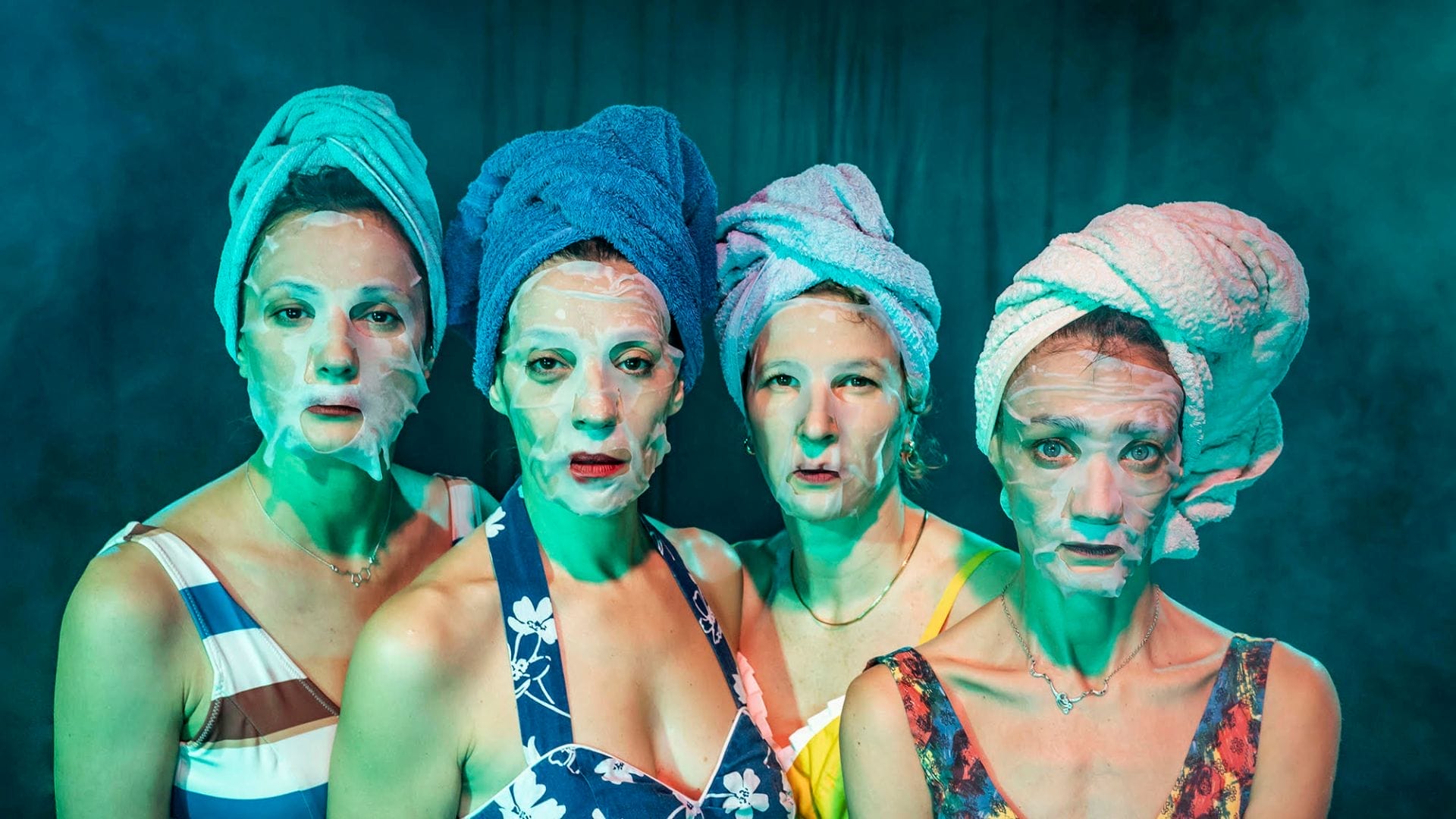
In this production, however, the ensemble (Caterina Carpio, Tania Garribba, Arianna Gaudio, Alice Palazzi) are significantly younger and much less individually recognisable. This turns the play’s apocalypse perspective, which should grow from inside their lived experience, into a more universalised philosophical reckoning that loses its fleshy ground. This is a play specifically about old women imagining the end of the world through their seemingly trivial, not‑worth‑mentioning lives. A massive point is therefore missing: the unsettling force simply of watching old women, almost at the end of their own apocalypse, still carrying on with their daily lives.
The overtly decorated French‑style garden can also be a bit problematic. Together with the AI‑animated screen, it all feels too pretentious and ‘performative’, which loses the quite devastating power in the play. Other than a normal British backyard you can see anywhere, this space is much more othered and objectified, just like the production per se, a delicate kitsch version of Churchill: polished, aestheticised, and safely distanced from raw friction. While it could be witty and elegant, it may lose some lingering taste continuing to haunt you long after the show.
Listings and ticket information can be found here