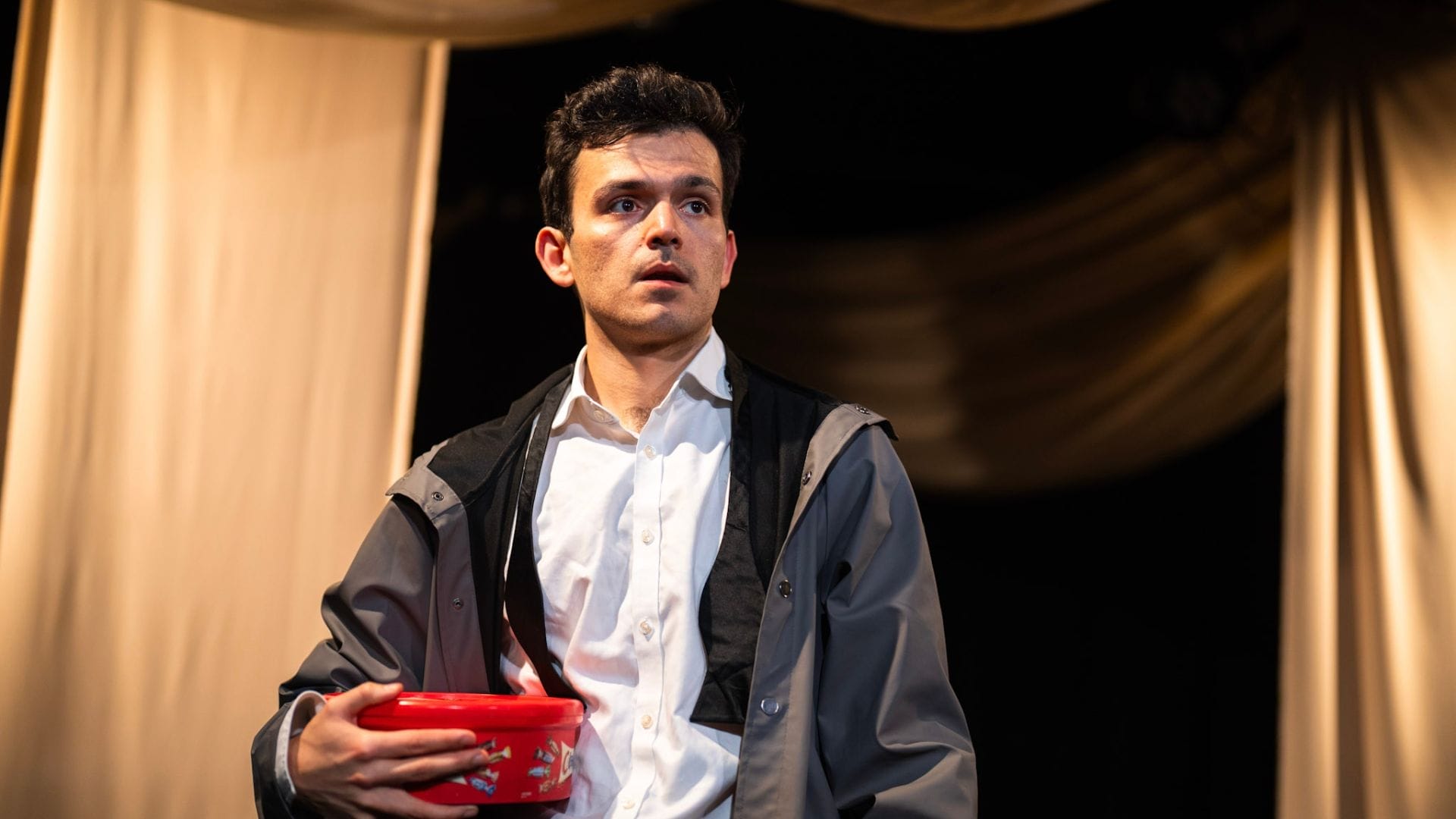


 Like Holding Water in Your Hand certainly isn’t the first play to bring the tragic Greek lovers Orpheus and Eurydice to the London stage. But at the Drayton Arms Theatre, directors Agnes Perry-Robinson and Felix Sutton, with Perry-Robinson also as writer, have brought the story to an apocalyptic present, with a biblical villain thrown in for good measure. The update works, and if the overall affair lacks some refinement, it compensates with a compelling central drama.
Perry-Robinson takes us to what appears to be modern-day Britain, except that it is beset by wildfires that keep the populace locked inside. COVID, climate change and the Grenfell disaster are obvious inspirations. Maud and Alex are behind on the rent for their dilapidated flat, drawing the attention of sadistic landlord Lot, yes, that Lot, complete with a pillar-of-salt ex-wife. He ingratiates himself into their lives, wheedling, blackmailing and manipulating them against one another. Whether or not love truly can conquer all is put to the test.
Perry-Robinson’s updated setting is a clever choice, as it allows her to explore the unfortunate social realities that tear relationships apart. Money, or rather the lack of it, is the Damoclean sword that hangs over Maud and Alex’s dreams of building a life together. Perry-Robinson makes some intriguing reflections on our often unsatisfied desire for control over our own lives, and the fickle nature of nostalgia.
The core story is a compelling one, with believable tension building between the central pair and the stakes feeling all too real. There are some especially strong scenes between Maud and the malevolent Lot as he fiendishly drives a wedge between the couple. His evil is almost caricaturish, but it works within the narrative, and is probably a rendition of a landlord that will draw sympathy from an audience of London renters.
It helps that the most assured performance of the night comes from Chris Westgate as Lot, bitter, sneering and foreboding. Alejandra Deane and Louis Street are a bit greener as Maud and Alex, but they’re likeable and have realistic chemistry.


Despite these strengths, Like Holding Water in Your Hand suffers from uneven writing. Some scenes shine while others feel bogged down with the weight of competing themes. Too often ideas are conveyed to us literally by the characters, whether it is Maud railing against the controlling ways of men or a dream scene that satirises both pap smears and politicians. Even in lockdown doldrums, it’s hard to believe Alex and Maud could indulge in quite so much navel gazing.
Add to that some slightly opaque references to the source mythologies, Orpheus, Eurydice and Lot’s wife Edith are all namechecked, and the viewer is left a little confused about what meaning to glean at the end of the story.
Like Holding Water in Your Hand is a play with good bones, but lacks the finesse to make the most of the promising central themes. Nonetheless, it’s a strong drama that offers plenty for an audience to sink their teeth into.
Listings and ticket information can be found here